Introduction
COST720 is a European COST Action which aims to Integrate Observing Systems to develop a ground-based remote sensing system for atmospheric profiling.
The Temperature hUmidity and Cloud (TUC) experiment was arranged under the auspices of COST720.
This experiment brought together observing systems from several European countries to Payerne, Switzerland during the winter of 2003-04.
Much of the participants' travel costs were funded by COST as Short Term Scientific Missions.
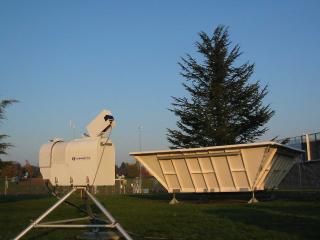
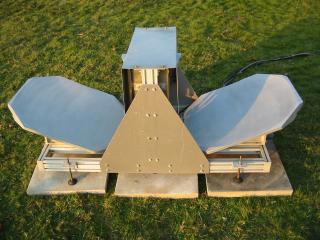
The Met Office deployed a microwave radiometer and a cloud radar at Payerne for the duration of TUC.
Liaison
Two Expert Group meetings were also organised at Payerne to plan the analysis of the data and encourage liaison between the different groups analysing the data.
The Met Office have been liaising most closely with:
- MeteoSwiss in the assessment of radiosondes' performance
- University of L'Aquila in the analysis of Wind Profiler data
- ... and the validation of microwave radiative transfer models
- University of Berne and Kipp & Zonen in microwave radiometer design, calibration and operation.
Although we also liaise with other groups in COST720.
Payerne
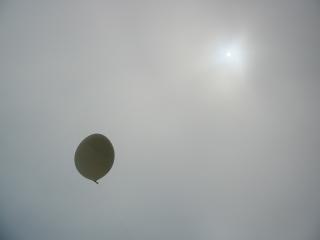
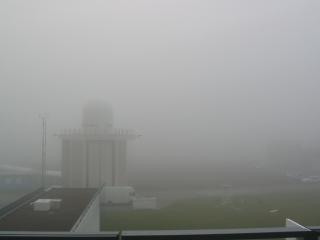
Payerne's geographical situation, in a broad valley, and nocturnal drainage flows frequently produce deep temperature inversions from the surface to 1km in winter.
Together with the moisture from nearby Lake Neuchatel, this often generates thick layers of fog or stratus.
In stable conditions, this makes it an ideal location to study these phenomena.
Payerne is MeteoSwiss' observation research centre and operational upper air station.
It provided a wide range of supporting instrumentation, which proved invaluable in the interpretation of the research instruments' measurements as well as for the validation of their retrievals.
The framework of TUC encouraged liaison with easy access to data and expertise in different instruments, essential when interpretting their data.
The hospitality and expertise of the MeteoSwiss staff also contributed to the success of TUC.
They provided a secure site with power and good network connections, and checked the instruments status daily during the 3 month experiment.
They also set up a website allowing data from all instruments to be viewed and transferred in near-realtime.
Data Analysis
Bringing together different observing systems onto one site allowed thorough analysis of the factors affecting each instrument with the aim of combining their data in integrated retrieval techniques.
Supporting instruments and radiosondes provide ground truth to validate these retrievals.
Met Office analysis of the data from TUC so has included:
- Validation of Radiative Transfer Models using microwave radiometers and radiosondes
- Validation of cloud base/tops retrievals using LCBR, infrared radiometer, radiosondes and cloud radar
- Analysis of microwave radiometer performance in fog, drizzle and rain using GPS IWV
- Analysis of factors influencing Wind Profiler Signal to Noise Ratio
Future analysis will include:
- Quantifying Wind Profiler signal due to inversions/hydrolapses
- Testing integrated retrievals with microwave radiometer based on this
Potential Future Experiments
The TUC experiment provided an excellent dataset to study the retrieval of temperature inversions, hydrolapses and fog formation/dissipation.
Another challenge facing the ground-based remote sensing community is the retrieval of static stability to study convection initiation.
These observations have the potential to aid the forecasting of convective storms and their associated extreme rainfall.
The Convective Storm Initiation Project (CSIP) provides an opportunity to study these phenomena and liaise with the modelling and data assimilation communities.
This campaign takes place in central Southern England in summer 2005, centred on the Chilbolton observatory with its suite of research radars.
Already there are plans to deploy the UFAM Wind Profiler to a location near Chilbolton.
This can be used together with the UHF radar at Chilbolton to study the influence of turbulence.
These studies could be further enhanced by including ground-based microwave radiometers, such as the Radiometrics MP3000, Radiometer Physics HATPRO, University of Bern's AMSUWARA and the Kipp & Zonen MTP5.
These have the potential to retrieve information on the static stability and ASMUWARA's azimuth scanning may provide a valuable insight into humidity convergence.
It is recommended that the Met Office deploy the MP3000 radiometer and radiosonde launches at the same site as the Wind Profiler.
It may be possible to encourage other COST720 partners to participate with their instruments if CSIP is funding is available as Short Term Scientific Missions.